 CUSTOM OPTICAL FILTERS
 OPTICAL WINDOWS
 OPTICAL COATINGS
 UV OPTICS
 CYLINDRICAL OPTICS
 CUSTOM TEMPERED OPTICS
 OPTICAL MIRRORS
 NEUTRAL DENSITY
 PRISMS & RETROREFLECTORS
 ASSEMBLIES
 OPTICAL LENSES
 NIGHT VISION FILTERS
 ACHROMATIC LENSES
 OPTICAL BEAM SPLITTERS
Hot Mirrors: How Optical Coatings Control Infrared Heat in Precision Optical Systems
Created at : Sep 11 2026
Managing light is about more than controlling what we can see. In many optical systems, infrared radiation travels alongside visible light, introducing heat that can interfere with sensitive components, affect performance, or create unwanted thermal loads. Hot mirrors provide an effective way to separate these portions of the spectrum.
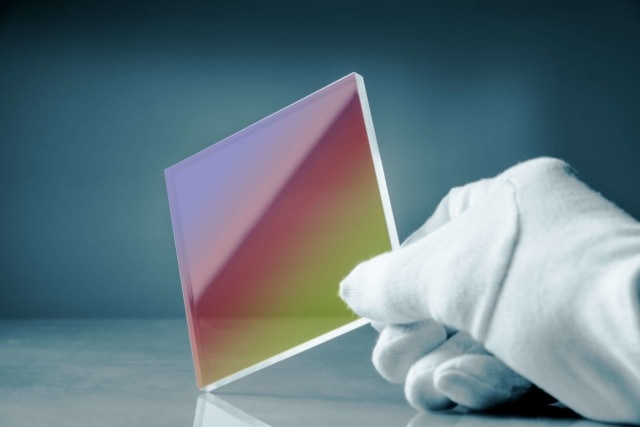
A hot mirror is a specialized coated optical component designed to transmit visible light while reflecting infrared radiation. By allowing useful visible wavelengths to continue through an optical system while redirecting heat-producing infrared energy, hot mirrors can provide valuable thermal management without substantially compromising illumination.
For demanding optical applications, the performance of a hot mirror depends heavily on the substrate, coating design, surface quality, dimensional accuracy, and overall precision of the finished optic. Sterling Precision Optics works with customers requiring custom optical components and coatings for applications where controlling wavelength transmission and reflection is critical.
What Is a Hot Mirror?
A hot mirror is a type of dichroic optical filter. Rather than treating all wavelengths of light the same way, its optical coating is engineered to produce different responses across selected portions of the electromagnetic spectrum.
In a typical hot mirror, visible wavelengths are transmitted through the optical component while infrared wavelengths are reflected away from the primary optical path.
This selective behavior is what gives the component its name. The "hot" portion of the incoming radiation—infrared energy associated with thermal effects—is reflected rather than allowed to continue through the system.
Hot mirrors can therefore be useful anywhere an optical design requires visible light but needs to minimize the amount of infrared radiation reaching downstream components.
Why Do Optical Systems Need Hot Mirrors?
A light source does not necessarily produce only the wavelengths required by an application. Depending on the source, a significant amount of energy may exist outside the useful visible spectrum.
Infrared radiation can be especially problematic because it can contribute to heat buildup.
Consider an optical illumination system. The system may need intense visible light to illuminate a target, specimen, sensor area, or projected image. At the same time, infrared energy generated by the source may travel along the same optical path.
Allowing that infrared radiation to reach the target can unnecessarily increase its temperature. It can also expose nearby lenses, filters, sensors, electronics, adhesives, housings, and other components to additional thermal energy.
A hot mirror provides a way to separate the useful visible light from much of this unwanted infrared radiation.
The visible portion passes through the hot mirror and continues toward its intended destination. Infrared wavelengths are reflected in another direction, reducing the amount of thermal energy continuing through the primary optical path.
Hot Mirrors Provide Optical Thermal Management
One of the most important purposes of hot mirrors is thermal management.
Optical engineers frequently need to consider heat alongside conventional optical characteristics such as transmission, reflection, focus, distortion, and wavelength response. Excessive thermal energy can affect components in ways that ultimately influence the performance or reliability of an entire assembly.
A hot mirror can reduce the infrared load placed on downstream components while preserving high transmission through the desired visible wavelengths.
This approach is particularly useful because a hot mirror primarily reflects unwanted infrared energy instead of simply absorbing it.
An absorptive filter may remove particular wavelengths from an optical path, but the absorbed energy has to go somewhere. Much of it becomes heat within the filter itself. Depending on the application, this can create additional thermal-management challenges.
A properly engineered hot mirror redirects targeted infrared wavelengths instead, making wavelength-selective reflection an important tool for controlling heat in precision optical systems.
How Do Hot Mirror Optical Coatings Work?
The performance of a hot mirror comes primarily from its optical coating.
Hot mirrors commonly use multilayer thin-film coatings deposited onto an optical substrate. These coatings consist of carefully controlled layers of materials with different optical properties.
Each layer can be extremely thin, and the thickness, refractive index, number, and sequence of the layers influence how different wavelengths behave when they encounter the surface.
The principle behind these coatings involves optical interference. Light reflected from the boundaries of individual coating layers interacts with light reflected from other layers. By engineering those interactions, coating designers can increase reflection across one wavelength range while maintaining transmission across another.
For a hot mirror, the coating system is designed so that a high percentage of desired visible wavelengths passes through while targeted infrared wavelengths are reflected.
The result is not simply "reflective glass." It is a precision optical filter whose spectral performance is deliberately engineered around the requirements of an application.
Hot Mirror Performance Can Be Customized
Not every hot mirror needs to perform exactly the same way.
Different optical systems use different light sources, sensors, wavelength ranges, geometries, operating environments, and performance requirements. As a result, the ideal transmission and reflection characteristics can vary considerably between applications.
The optical coating may need to be designed around a particular visible transmission range or infrared reflection band. Engineers may also need to consider the transition between transmitted and reflected wavelengths.
Angle of incidence is another important consideration. Optical coatings can behave differently depending on the angle at which light strikes the surface. A hot mirror designed for light arriving approximately perpendicular to its surface may require a different coating design from one intended for operation at a significant angle.
Operating temperature, environmental exposure, substrate selection, surface quality, coating durability, and dimensional tolerances can also influence the final design.
This is one reason custom optical manufacturing can be so valuable. Instead of trying to adapt an optical system around an off-the-shelf filter, engineers can specify a component that more closely matches the system's actual optical and mechanical requirements.
Hot Mirrors vs. Cold Mirrors
Hot mirrors and cold mirrors are closely related optical components, but their functions are essentially reversed.
A hot mirror typically transmits visible light while reflecting infrared radiation. Its purpose is often to keep visible illumination in the primary optical path while redirecting heat-producing IR wavelengths.
A cold mirror generally reflects visible wavelengths while transmitting infrared radiation.
Which component is appropriate depends on the desired optical path.
If an application needs visible light to pass through while infrared energy is redirected, a hot mirror may be appropriate. If visible light needs to be reflected while infrared wavelengths continue through the optic, a cold mirror may provide the required spectral behavior.
Both demonstrate the capabilities of modern optical coatings. Instead of merely reflecting or transmitting light broadly, coated optics can be engineered to manipulate selected wavelength bands.
Applications for Hot Mirrors
Hot mirrors can be incorporated into a wide range of optical and electro-optical systems.
High-intensity illumination is one important area. When a light source produces useful visible illumination along with significant infrared radiation, a hot mirror can help deliver the visible portion while limiting unwanted heat at the illuminated target.
Imaging and machine vision systems can also benefit from careful wavelength management. Sensors and other components may perform best when the incoming spectral range is controlled. A hot mirror can become part of a larger filtering strategy designed around the detector and illumination source.
Scientific and laboratory instrumentation may require even more carefully defined wavelength characteristics. In these systems, hot mirrors can be combined with additional filters, lenses, windows, prisms, mirrors, and other optical components to achieve the desired spectral response.
Hot mirrors may also have applications in medical, aerospace, defense, projection, sensing, and other specialized optical systems where controlling both light and thermal energy is important.
The Optical Substrate Matters Too
Although the coating gives a hot mirror its wavelength-selective properties, the underlying substrate remains an important part of its performance.
Optical glass must provide the required transmission characteristics while also meeting specifications for flatness, surface quality, thickness, dimensional accuracy, and environmental performance.
Substrate selection can depend on the wavelength range, operating environment, thermal requirements, mechanical design, and coating process.
Materials such as optical glass and fused silica may be considered depending on the particular application and spectral requirements. The best material is therefore not determined by the fact that the component is a hot mirror alone. It must be evaluated as part of the complete optical system.
Precision fabrication of the substrate before coating is equally important. Even an advanced coating cannot compensate for an optic that fails to meet the required dimensional or surface specifications.
Precision Matters in Custom Hot Mirror Manufacturing
A hot mirror illustrates why optical manufacturing involves much more than producing a piece of glass in the correct shape.
Its mechanical dimensions must fit the assembly. Its optical surfaces must meet the required quality. The substrate must provide appropriate optical and physical characteristics. Most importantly, the coating must achieve the required spectral performance.
Those characteristics need to work together.
Small differences in coating design can affect where transmission ends and reflection begins. Changes in angle of incidence can shift spectral performance. Surface imperfections can influence optical quality, while dimensional errors can create problems when the component is integrated into an assembly.
Working with an experienced precision optics manufacturer gives engineers the opportunity to consider these requirements together rather than treating fabrication and coating as unrelated decisions.
Custom Optical Coatings Expand What an Optic Can Do
Hot mirrors are also an excellent example of the broader value of custom optical coatings.
An uncoated piece of optical glass has characteristics largely determined by the material itself. Applying engineered thin-film coatings makes it possible to significantly modify how that component interacts with specific wavelengths.
Depending on the application, coatings can be designed to increase transmission, reduce unwanted reflections, selectively reflect certain wavelength bands, separate portions of the spectrum, or provide other specialized optical characteristics.
This allows what appears to be a relatively simple optical window or mirror to become a highly functional part of a much more sophisticated optical system.
For designers, that creates opportunities to solve problems through the optical component itself. Instead of relying exclusively on mechanical cooling or additional system components to address infrared heat, for example, an appropriately designed hot mirror may remove a significant portion of unwanted radiation directly from the optical path.
Hot Mirrors from Sterling Precision Optics
When optical systems require precise control over visible and infrared wavelengths, the details of the optical component matter.
Sterling Precision Optics provides precision optical manufacturing capabilities for customers requiring components such as lenses, prisms, windows, filters, mirrors, cylinder optics, and optical assemblies. Custom coating capabilities can further tailor these components to the spectral requirements of demanding applications.
For hot mirror applications, that means considering the entire component: substrate material, geometry, surface specifications, wavelength requirements, angle of incidence, transmission goals, infrared reflection requirements, and the environment in which the finished optic will operate.
The objective is not simply to manufacture a mirror. It is to produce an optical component that performs a specific job within a larger system.
Control Light and Heat with Precision Hot Mirrors
Hot mirrors perform an important but deceptively simple function: they help optical systems keep the visible light they need while redirecting infrared energy they do not.
Behind that function is sophisticated optical engineering. Precision substrates and multilayer thin-film coatings work together to determine which wavelengths pass through the component and which are reflected.
For applications involving illumination, imaging, sensing, scientific instrumentation, aerospace, defense, medical equipment, and other precision optical technologies, that ability to manage both light and heat can make hot mirrors an important part of system design.
Companies searching for custom hot mirrors, precision optical filters, custom optical coatings, or coated optical components can work with Sterling Precision Optics to develop optics manufactured around the specific requirements of their applications.